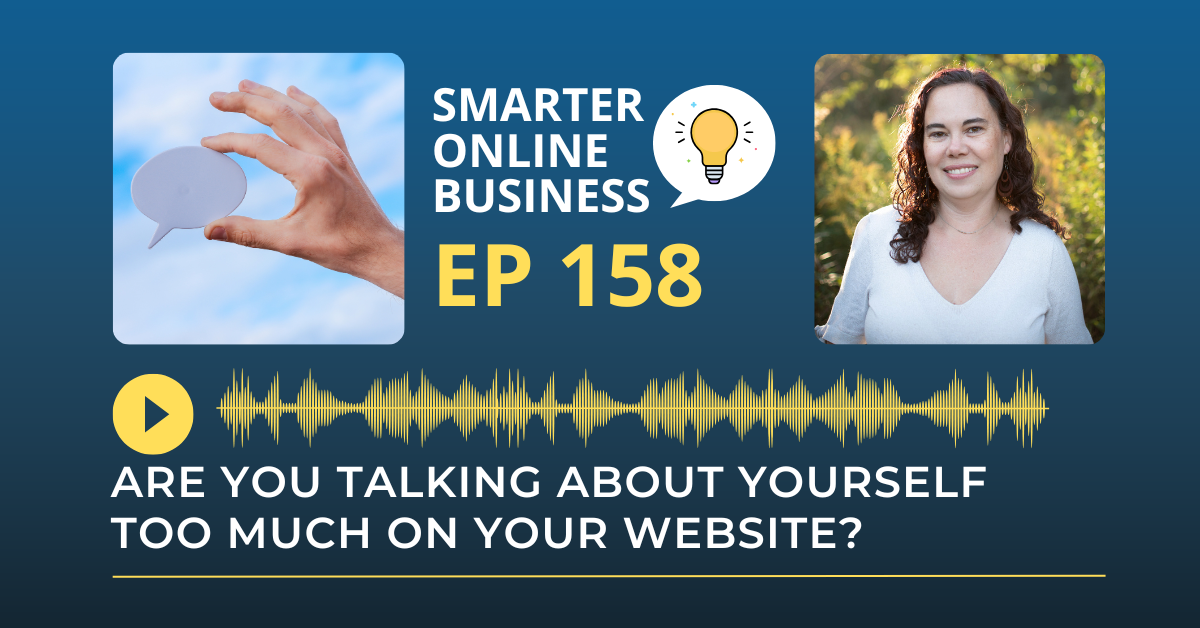
Let me ask you a quick question: when someone lands on your website, is it mostly about you or about them?
This is one of the most common issues I see with websites. They look great, sound professional, and list all the right credentials, yet they still struggle to convert visitors into customers.
The reason is often surprisingly simple. The website is talking about the business owner just a little too much.
In this episode, we’re breaking down why this happens, and it’s probably not for the reason you think. We’ll talk about how this approach quietly hurts your conversions and, more importantly, what you can say instead so your website actually connects with the people visiting it. I’ll also share a simple test you can run on your homepage today to quickly see whether this might be happening on your own site.
Let’s Recap: Are You Talking About Yourself Too Much on Your Website?
Search is changing fast, but the goal behind search engine optimization is not going anywhere: getting your business discovered by the right people at the right moment. What’s new is how that discovery happens. More users now turn to tools like ChatGPT, Claude, Bing, and Google’s AI-powered results for answers. These tools often summarize information without sending the same volume of organic traffic to websites.
That shift has many business owners asking if SEO is dead. A better question is this: how is SEO evolving into AI optimization (AIO), and what should you focus on to keep your site visible, trusted, and profitable even when fewer people click?
When a website fails to convert, the problem is often not the design, traffic, or even pricing. More often, the issue is messaging that focuses on the business owner instead of the visitor.
Many coaches, course creators, and e-commerce founders build homepages that read like resumes. They highlight years of experience, credentials, long origin stories, and detailed processes. While this may look professional, it often misses the first questions a new visitor is asking:
- Am I in the right place?
- Can you help with my problem?
- Is this for someone like me?
Conversion rate optimization starts with empathy. Visitors arrive scanning for instant clarity. If they cannot quickly see that you understand their problem and offer a solution, they leave, even if you are highly qualified.
Why Business Owners Default to Self-Focused Copy
This habit is understandable because credibility feels safe. Business owners are constantly told to prove expertise, list certifications, and establish authority.
None of that is wrong. The issue is the order in which it appears.
A website is not a brochure or a biography. It is a decision-making tool designed to guide someone toward a next step, whether that is booking a call, joining an email list, or purchasing a product.
The strongest websites work like a sales tool that operates around the clock. But that only happens when the top of the page creates connection before credibility. Visitors need to see themselves in your message first. Trust is built more effectively after that connection is made.
Common Website Messaging Mistakes
A practical way to identify this issue is to look for a few common red flags.
Leading With Yourself
If your homepage begins with something like:
“Hi, I’m Carrie and I do…”
the visitor has to work to translate your identity into a benefit for them.
Sharing Your Story Too Soon
Long paragraphs about your background before mentioning the customer’s problem can bury the most important message.
Listing Credentials Without Context
Credentials matter, but if visitors do not yet understand why they should care, those details can feel like noise instead of reassurance.
Explaining Process Instead of Outcomes
Even a detailed explanation of your process can become subtly self-focused if it replaces the outcome.
Strong conversion copy emphasizes what changes for the customer:
- The result
- The relief
- The time saved
- The revenue gained
- The transformation they want
A Simple Framework for Better Homepage Copy
One of the easiest ways to improve homepage messaging is to use this framework:
I help [who] solve [problem] so they can [result].
This structure immediately creates clarity and connection.
Once visitors understand that you can help them, you can layer in credibility through:
- Testimonials
- Case studies
- Results
- A short supporting story
- Relevant experience or certifications
Your deeper personal story is still valuable, but it typically works better on the About page or in supporting sections where it strengthens trust instead of competing with clarity.
Run a Quick Website Messaging Audit
Here is a simple exercise you can do today:
Read the first section of your homepage and count how many times you use:
- I
- We
- Our
Then compare it to:
- You
- Your
If the messaging leans heavily toward you, rewrite it until the visitor feels understood.
Because when people feel understood, they are far more likely to click, stay, and buy.
Rate, Review, & Follow on Apple Podcasts
If you’re loving my eCommerce Made Easy Podcast, I’d be thrilled if you could rate and review the show on Apple Podcasts. Your ratings and reviews help me reach more listeners and empower more people like you to thrive in the online business world.
Just click here to head over to Apple Podcasts, scroll down, give us a five-star rating, and share what you enjoyed most about the episode in the “Write a Review” section.
If you haven’t hit that follow button yet, now’s the perfect time! I have new episodes coming your way every week that you won’t want to miss. Hit the follow button and stay up to date with the eCommerce Made Easy Podcast! Follow Now!
What a ‘Smart Sales Tool’ Website Actually Looks Like